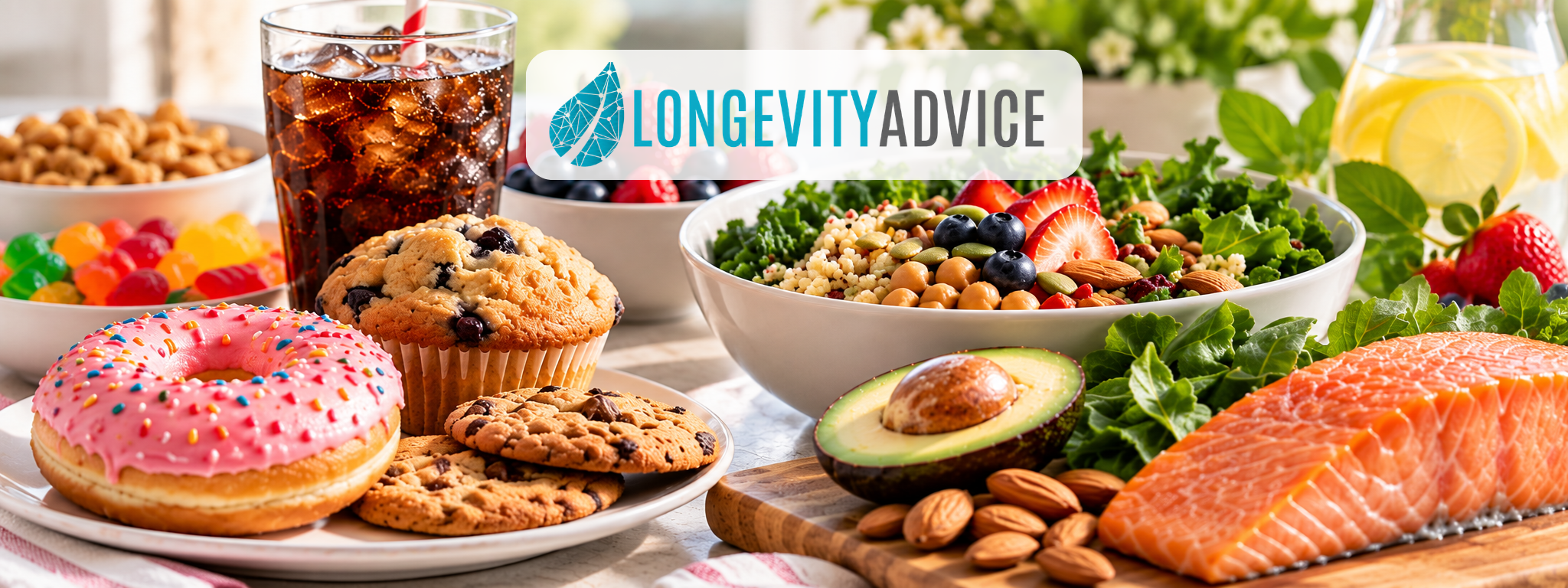
That is one reason I was pleased to contribute as a nutrition expert to Longevity Advice in its article “Sugar and Aging: What You Need to Know,” which explores the science behind sugar and biological aging.1
The article examines several mechanisms associated with aging, including glycation, inflammation, blood sugar regulation, and metabolic health. There is an important distinction I emphasized in the article:
In other words, the goal is not to fear carbohydrates or eliminate every gram of sugar from your diet.
As with most things in nutrition, the story is much more nuanced.
Your Body Uses Glucose. That Doesn’t Mean More Sugar Is Better.
Carbohydrates are broken down into glucose, which the body can use as an important source of energy.
But there is a substantial nutritional difference between carbohydrates from whole foods and large amounts of added sugar.
Vegetables, fruit, legumes, and other minimally processed carbohydrate-containing foods can provide fiber, vitamins, minerals, antioxidants, and phytonutrients along with naturally occurring sugars.
Added sugars, on the other hand, are sugars or syrups added to foods during processing or preparation, or at the table.
The American Heart Association recommends that most women limit added sugar to approximately 6 teaspoons (25 grams) per day.2
And this is where things can get tricky.
Added sugar isn’t found only in cookies, cakes, and candy. It can quietly accumulate in foods many people consider “healthy,” including:
- Flavored yogurt
- Granola and protein bars
- Cereals and flavored oatmeal
- Coffee drinks
- Smoothies and bottled juices
- Salad dressings
- Sauces and condiments
- Packaged snack foods
A food can wear a convincing health halo and still contain a surprising amount of added sugar.
Sugar and Aging: Understanding Glycation
One of the most interesting connections between sugar and aging involves compounds called advanced glycation end products, or AGEs.
AGEs form when sugars react with proteins or fats in the body. They accumulate naturally with age, but excessive glycation is linked to changes in long-lived structural proteins, oxidative stress, and age-related disease processes.3
Collagen and elastin are particularly important because they are long-lived proteins and therefore vulnerable to these changes over time. Glycation can alter their structure and function, which is one reason researchers have extensively studied AGEs in relation to skin aging.3
An easy way to visualize glycation is to think of it as a type of slow internal “browning” process. It isn’t literally caramelization inside your body, of course, but the analogy helps explain how sugar can gradually interact with and alter proteins.
What About Sugar and Inflammation?
Inflammation is not inherently bad.
Your body needs a healthy inflammatory response to fight infection, respond to injury, and repair tissue. The concern is when inflammatory signaling becomes persistent or dysregulated.
The relationship between dietary sugar and inflammation is complex. Research suggests that the food source, total energy intake, overall dietary pattern, and type of sugar all matter, and that studies do not support labeling all forms of sugar as equally inflammatory.4
That’s an important distinction.
A cup of berries is not metabolically equivalent to a sugar-sweetened soda simply because both contain sugar.
Whole fruit comes packaged with fiber, water, vitamins, minerals, polyphenols, and other plant compounds. Nutrition needs to be considered in context rather than reducing food to a single ingredient.
So, What Does Any of This Have to Do With Hair?
Here’s where I want to be very clear:
Female hair thinning and alopecia are complex, and there is rarely one single culprit.
But your hair follicles don’t live in isolation from the rest of your physiology.
They depend on an intricate biological environment influenced by factors such as:
- Nutrient status
- Hormonal signaling
- Thyroid function
- Metabolic health
- Blood sugar regulation
- Inflammation
- Gut health
- Immune activity
- Stress
- Medications
- Illness
- Genetics
- Rapid weight loss
That is why assessing metabolic health can sometimes be an important part of investigating unexplained hair changes.
For example, research on middle-aged women has reported an association between insulin resistance-related factors and androgenetic hair loss, although this association does not mean insulin resistance directly causes the hair loss.5
Researchers have also identified inflammatory activity around hair follicles and inflammatory signaling as potential contributors to female and male pattern hair loss.6
So the takeaway isn’t:
It’s more accurate to say:
Metabolic health matters, and in some women, blood sugar dysregulation, insulin resistance, inflammation, or related metabolic factors may be pieces of a much larger hair-loss puzzle.
That distinction matters.
Why I Look Beyond the Hair Follicle
This is exactly why I don’t like reducing hair loss to:
Try this serum.
Use this shampoo.
Those approaches may have a place, but they don’t necessarily explain why the hair changed in the first place.
Hair deserves more than a cosmetic conversation.
If someone’s diet is repeatedly contributing to significant blood-sugar fluctuations while also crowding out quality protein, healthy fats, fiber, minerals, antioxidants, and other nutrient-dense foods, that becomes part of the bigger picture I want to investigate.
The same is true when hair loss appears alongside symptoms or signs involving metabolism, hormones, digestion, inflammation, nutrient status, thyroid function, or significant weight changes.
The question becomes less about finding one magic culprit and more about connecting the dots.
5 Ways to Support Blood Sugar, Healthy Aging & Hair
You don’t need to strive for a “zero-sugar” life.
Instead, focus on improving the overall quality, balance, and nutrient density of your diet.
1. Prioritize Quality Protein
Include a quality protein source at meals.
Hair is primarily composed of keratin, a protein, and adequate protein intake becomes especially important during periods of calorie restriction, rapid weight loss, GLP-1 medication use, and healthy aging.
Protein also helps create more balanced, satisfying meals.
2. Pair Carbohydrates Strategically
Instead of routinely eating refined carbohydrates by themselves, combine carbohydrate-containing foods with protein, fiber, and/or healthy fats when appropriate.
For example, compare:
An apple by itself
with:
An apple with a handful of walnuts or almond butter.
Same apple. Very different meal composition.
3. Let Whole Foods Do Most of the Work
Build the foundation of your diet around foods such as:
- Colorful vegetables
- Quality protein
- Berries and other whole fruits
- Legumes
- Nuts and seeds
- Healthy fats
- Herbs and spices
- Minimally processed foods
This naturally increases nutrient density while reducing your reliance on highly processed sources of added sugar.
4. Read the “Added Sugars” Line
Don’t rely solely on front-of-package claims such as:
Natural. Organic. Plant-based. Healthy. High-protein.
Turn the package around.
The Added Sugars line on the Nutrition Facts panel often tells a much more useful story.
5. Look at the Whole Metabolic Picture
If you are experiencing persistent or unexplained hair thinning along with concerns such as fatigue, cravings, changes in body composition, blood-sugar issues, hormonal changes, rapid weight loss, or other symptoms, simply adding another hair supplement may not address what is happening.
There may be value in investigating the bigger picture.
Ready to Cut Back on Sugar Without the Guesswork?
Knowing where added sugar hides is one thing. Changing your everyday habits is another.
My Quit Sugar Now eGuide gives you practical strategies to help identify hidden sugars, make smarter food choices, and reduce added sugar without feeling like you have to give up everything you enjoy.
Hair Can Be a Messenger
One of the most important things I have learned in more than a decade of working in functional nutrition is that hair can provide clues about what is happening elsewhere in the body.
That doesn’t mean every case of hair loss is caused by nutrition, blood sugar, hormones, gut health, or inflammation.
It means we need to ask better questions.
Instead of asking only:
I often want to know:
What is happening inside the body that could be affecting the conditions necessary for healthy hair growth?
That shift changes the investigation.
Healthy Aging and Healthy Hair Have More in Common Than You Might Think
The foundations of healthy aging and healthy hair overlap in many ways:
Metabolic health. Nutrient sufficiency. Blood-sugar regulation. Healthy inflammatory balance. Protein intake. Movement. Sleep. Stress management. And understanding your individual physiology.
No single food determines how quickly you age.
And no single food determines whether you will lose your hair.
But the patterns you repeat day after day can influence the biological environment in which your cells, tissues, and hair follicles have to function.
That’s why I prefer to look at the whole picture.
If your hair is changing, don’t automatically assume the answer is another shampoo, serum, supplement, medication, or procedure.
Your hair is telling a story. We know how to investigate it.
Concerned About More Than Sugar?
If your hair is thinning or changing, blood sugar may be only one piece of the puzzle.
Stop guessing. Start investigating.
Featured In
Julie Olson was quoted as a nutrition expert in Longevity Advice’s “Sugar and Aging: What You Need to Know,” discussing the roles carbohydrates and glucose play in cellular energy and human physiology.1
References
1. Burger R. Sugar and Aging: What You Need to Know.
Longevity Advice. Updated January 9, 2024.
View Source →
2. American Heart Association. Added Sugars.
American Heart Association.
View Source →
3. Gkogkolou P, Böhm M. Advanced glycation end products: Key players in skin aging?
Dermatoendocrinology. 2012;4(3):259–270.
doi:10.4161/derm.22028. PMID: 23467327.
4. Della Corte KW, Perrar I, Penczynski KJ, Schwingshackl L, Herder C, Buyken AE.
Effect of dietary sugar intake on biomarkers of subclinical inflammation:
A systematic review and meta-analysis of intervention studies.
Nutrients. 2018;10(5):606.
doi:10.3390/nu10050606. PMID: 29757229.
5. Matilainen V, Laakso M, Hirsso P, Koskela P, Rajala U, Keinänen-Kiukaanniemi S.
Hair loss, insulin resistance, and heredity in middle-aged women:
A population-based study.
Journal of Cardiovascular Risk.
2003;10(3):227–231.
doi:10.1097/01.hjr.0000070200.72977.c6.
PMID: 12775957.
6. Peyravian N, Deo S, Daunert S, Jimenez JJ.
The inflammatory aspect of male and female pattern hair loss.
Journal of Inflammation Research.
2020;13:879–881.
doi:10.2147/JIR.S275785.
PMID: 33204138.